
INTERBUS Router
A-IBR
The Aparian INTERBUS Router (A-IBR) provides intelligent data routing between legacy INTERBUS networks and modern EtherNet/IP or Modbus TCP systems. The module connects to an existing INTERBUS master and can emulate up to 15 INTERBUS slave devices, allowing input and output data to be exchanged with industrial controllers and other compatible devices.
The INTERBUS Router enables the integration of legacy INTERBUS equipment with Rockwell Automation ControlLogix and CompactLogix controllers, as well as other Modbus-enabled systems. It supports EtherNet/IP Target and Originator modes, including Class 1 I/O connections, Explicit Messaging, and Direct-To-Tag Logix data access.
The module supports INTERBUS communication at 500 kbps and 2 Mbps. Configuration and diagnostics are provided through Aparian Slate software, including Logix L5X file generation for Studio 5000 import. Dual Ethernet ports with Device Level Ring (DLR) support provide additional network connectivity options.
- Module can emulate up to 15 INTERBUS slaves.
- Supports all INTERBUS Baud Rates (500 kb & 2 Mb).
- Logix L5X generation – ready for Studio 5000 import.
- Primary interface modes:
- EtherNet/IP Target (Class 1 connection)
- EtherNet/IP Originator (Class 1 connection with up to 15 EtherNet/IP devices and Explicit Messaging, including Direct-To-Tag Logix tag access, with up to 10 EtherNet/IP devices).
- Modbus TCP Server
- Modbus TCP Client
- Slate software provides a Modbus packet capture utility for better diagnosis of issues.
- Dual Ethernet ports with Device Level Ring (DLR) support.
- Network Time Protocol (NTP) supported.
- Small form factor – DIN rail mounted.

Overview
The module supports one of four Primary Interface modes:
EtherNet/IP Target
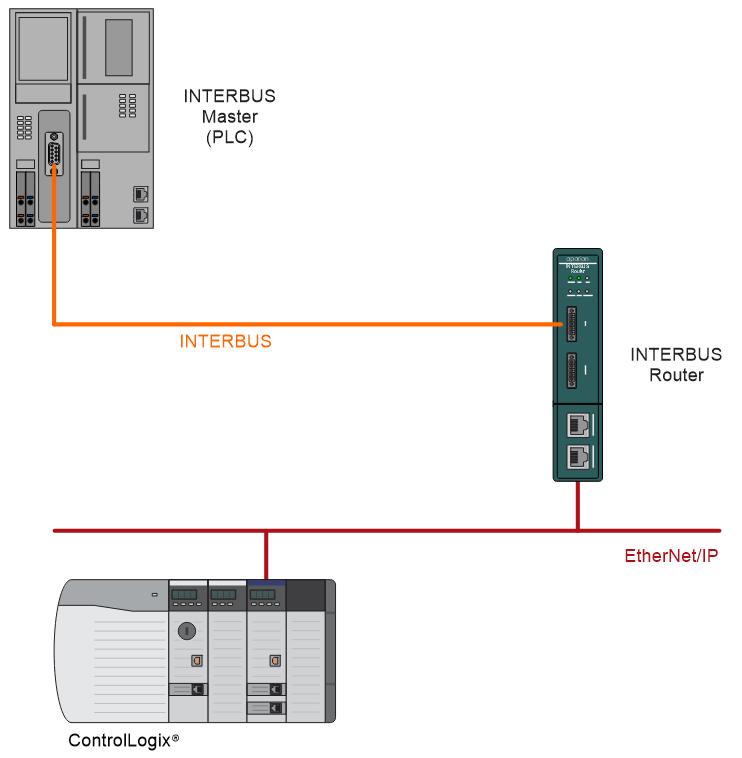
Here a remote EtherNet/IP device (e.g. a Logix controller) establishes a number of Class 1 connections to the module. INTERBUS data can be mapped into 4 separate input and output class 1 cyclic connections to the Logix controller (allowing up to 2KB input and 2KB output to be exchanged at the requested packet interval – RPI).
EtherNet/IP Originator
As an EtherNet/IP originator, the module can use one of two methods to read and write data to and from the INTERBUS master:
- EtherNet/IP Explicit Messaging
This allows an INTERBUS master to exchange data with up to 10 EtherNet/IP devices. The module can use either Class 3 or Unconnected Messaging (UCMM) to Get and Set data in the remote EtherNet/IP devices.
- Direct-To-Tag technology
This allows the INTERBUS master to exchange data with a Logix controller without the need to write any application code (e.g. ladder) in Studio 5000. The INTERBUS slave data is directly read from, or written to, Logix tags.
- EtherNet/IP Class 1 connection
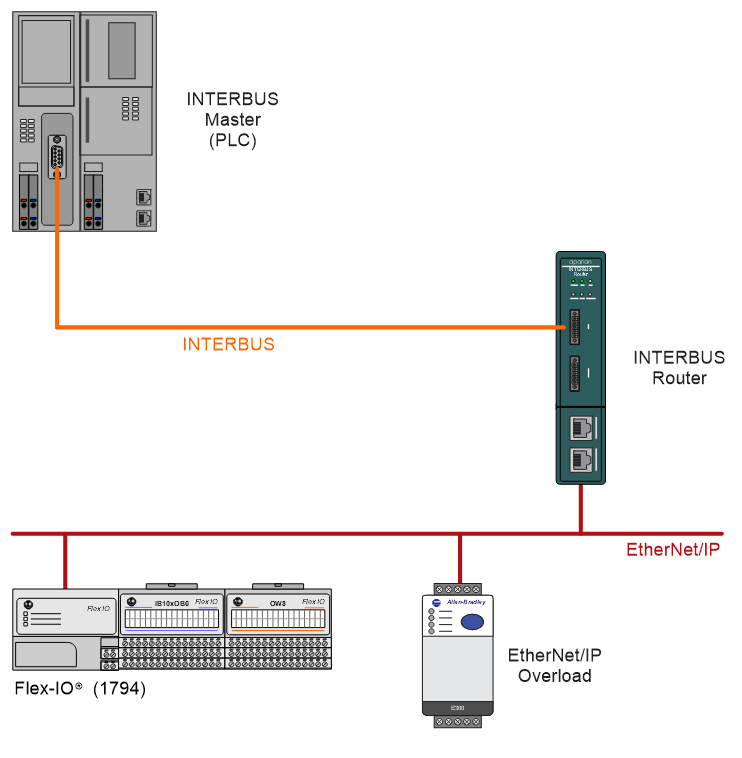
INTERBUS data can be mapped to a maximum of 15 EtherNet/IP devices using input and output class 1 cyclic connections. This will allow the INTERBUS Router to “own” the EtherNet/IP target device and exchange INTERBUS slave data using the EtherNet/IP device’s input and output assemblies.
Modbus Server
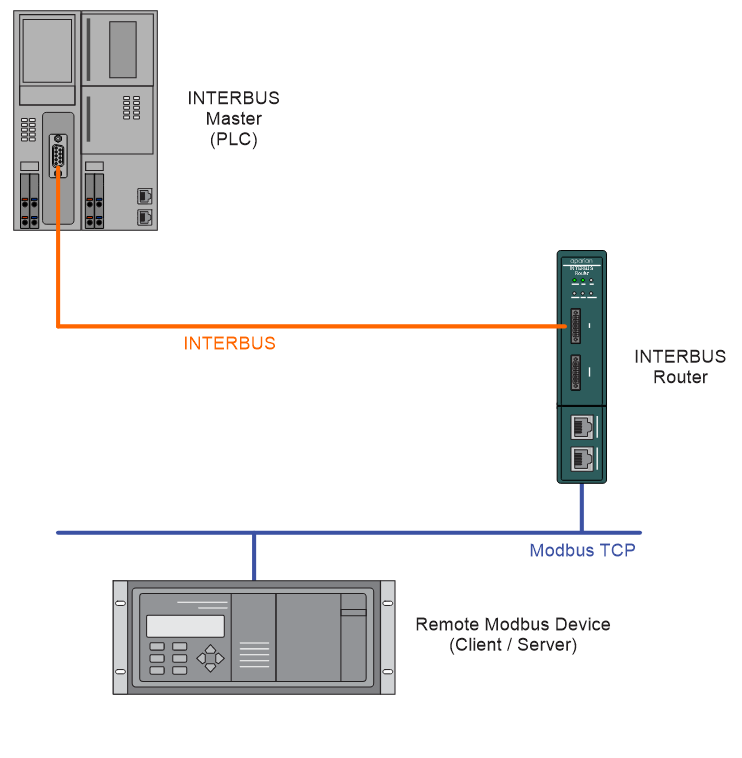
The diagnostics and INTERBUS data will be written to, or read from, the module’s internal Modbus Registers (Holding or Input Registers). These registers can be accessed by a remote Modbus Client using Modbus TCP.
Modbus Client
The diagnostics and INTERBUS data will be written to, or read from, the module’s internal Modbus Registers (Holding or Input Registers). The Modbus Auxiliary Map can then be used to configure the Modbus data exchange between multiple remote Modbus Server devices and the module’s internal Modbus registers via Modbus TCP.
When configured as an EtherNet/IP Target, the software can generate an L5X file which can be imported into Studio 5000. This provides all the necessary UDTs, Tags and mapping ladder to allow the Logix application code to easily access the INTERBUS data.
The INTERBUS Router is configured using the Aparian Slate application. This program can be downloaded from www.aparian.com free of charge.
The module also provides a range of statistics, INTERBUS packet capture functions, and internal Modbus and data table reads to simplify remote diagnosis.
The module has two Ethernet ports and supports Device-Level-Ring (DLR) architectures.
Application
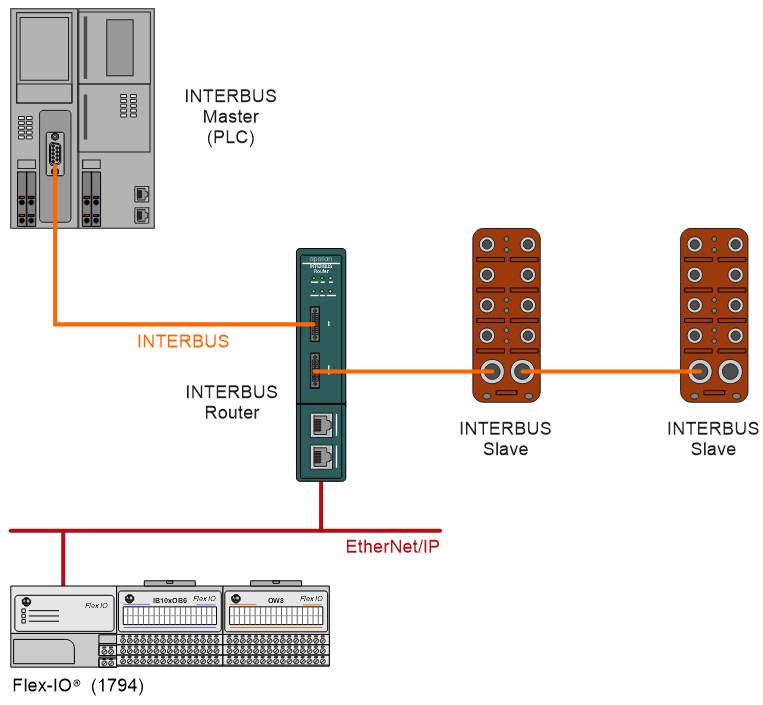
The figures below provide an example of the typical network setup for connecting INTERBUS devices to either EtherNet/IP or Modbus TCP.
Example of connecting to a Logix Controller:
Example of connecting EtherNet/IP IO:
Example of connecting to a Modbus TCP Client or Server:
Example of extending INTERBUS to additional INTERBUS slaves:
Specification
Electrical
| Specification | Rating |
| Power requirements | Input: 10 – 32 VDC (Class 2) |
| Power consumption | 3.0 W (Max.) Current: 260 mA @ 10 V Current: 120 mA @ 24 V |
| Connector | 3-way terminal |
| Conductors | 24 – 18 AWG |
| Enclosure rating | IP20, NEMA/UL Open Type |
| Temperature | -20 – 70 °C |
| Earth connection | Yes, terminal based |
| Emissions | IEC61000-6-4 |
| ESD Immunity | EN 61000-4-2 |
| Radiated RF Immunity | IEC 61000-4-3 |
| EFT/B Immunity | EFT: IEC 61000-4-4 |
| Surge Immunity | Surge: IEC 61000-4-5 |
| Conducted RF Immunity | IEC 61000-4-6 |
Ethernet
| Specification | Rating |
| Connector | RJ45 |
| Conductors | CAT5 STP/UTP |
| ARP connections | Max 20 |
| TCP connections | Max 20 |
| CIP connections | Max 15 |
| Communication rate | 10/100Mbps |
| Duplex mode | Full/Half |
| Auto-MDIX support | Yes |
| Embedded Switch | Yes, 2 x Ethernet ports |
| Device Level Ring (DLR) | Supported |
| Network Time Protocol (NTP) | Supported |
INTERBUS Ports
| Specification | Rating |
| Connector | 5-way terminal |
| Conductor | 24 – 18 AWG |
| Electrical Isolation | 1000 Vrms for 1 minute. |
INTERBUS
| Specification | Rating |
| Type | Slave |
| Max. Device Count | 15 |
| Max. Total INTERBUS Data | 128 bytes |
| Max. Summation Frame | 128 bytes |
| Paramter Channel (PCP) | Not Supported |
| Supported BAUD Rates | 500 kbps, 2 mbps |
EtherNet/IP Originator
| Specification | Rating |
| Class 1 Cyclic Connections Supported | Yes |
| Class 3 / UCMM Connections Supported | Yes |
| Class 1 Connection Count | 15 |
| Class 3 / UCMM Target Device Count | 10 |
| Class 3 / UCMM Mapping Count | 50 |
Ethernet/IP Target
| Specification | Rating |
| Class 1 Cyclic Connection Count | 1 - 4 |
| Logix Direct-to-Tag Supported | Yes |
Certifications
| Specification | Rating |
| CE Mark |  |
|
UL Listed FILE: E494895 |
CLASS 1, DIV 2, GROUPS A, B, C, D T4A
|
| UKCA |  |
| ODVA Conformance |  |
| RoHS2 Compliant |  |

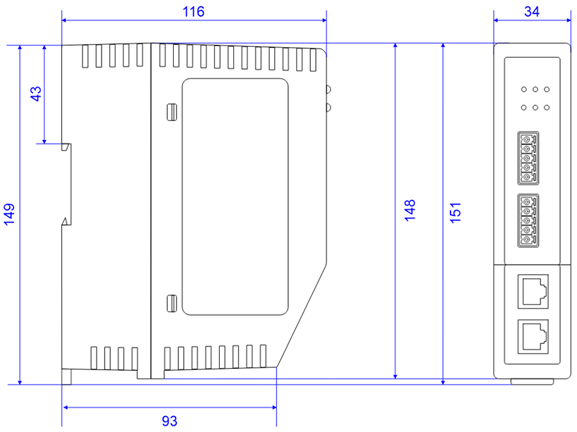
Dimensions

Downloads
Documents
 INTERBUS_Router User Manual - Rev 1.2 INTERBUS Router Datasheet - Rev 1.2 INTERBUS Router Quick Start Guide - Rev 1.0
Examples
EDS Files
 INTERBUS_Router_EDS - Rev 1.0
Firmware
 INTERBUS Router Firmware - Rev 1.001.009